How to Choose an AI Agent Platform for Your Team
Contents
Most teams evaluating an AI agent platform compare feature lists and demo videos, then discover months later that the demo and the production job were not the same thing. This is a vendor-agnostic framework for how to choose an AI agent platform: why pilots stall, six criteria that actually predict whether a platform survives contact with real work, the governance rules now attached to that decision, and a scorecard you can apply to any product on your shortlist.
Why most AI agent pilots never reach production
An estimated 88% of AI agent pilots fail to reach production, according to an analysis of enterprise deployments compiled by Digital Applied (Digital Applied, AI agent failure framework). Gartner forecasts the same trend from the vendor side: more than 40% of agentic AI projects will be canceled by the end of 2027 due to escalating costs, unclear business value, or inadequate risk controls (Gartner, press release, cited via Digital Applied’s agent-washing scorecard). Gartner Senior Director Analyst Anushree Verma named the underlying problem directly: “most agentic projects today are early-stage experiments driven by hype,” which blinds organizations to the real cost and complexity of deploying agents at scale.
The failure pattern is not random. Digital Applied’s breakdown attributes 34% of failed pilots to scope creep, where an initially bounded automation absorbs new requirements until it becomes an open-ended reasoning system nobody scoped for. Data quality failures account for another 27%, when an agent tested against clean sample data meets production records full of incomplete fields and stale formatting. Security and access-control blockers cause 14% of failures, integration complexity accounts for 9%, and governance gaps, missing ownership, monitoring, or incident response, cause another 5% (Digital Applied, AI agent failure framework). Scope and data readiness alone explain most of the gap between a working demo and a working system.
This is also an active buying decision for most teams, not a settled one. Only 17% of organizations had deployed AI agents as of 2026, while more than 60% expect to deploy within two years, per Gartner’s CIO survey (Digital Applied, agent-washing scorecard). The evaluation criteria below are aimed at that gap: the difference between a platform that produces a good pilot and one that keeps producing good results after the third team starts depending on it.
The AI agent evaluation checklist: 6 criteria that separate a pilot from a platform
Feature lists answer “can it do the task once, in a demo.” These six criteria answer “will it still be trustworthy after the fifth team is running unsupervised jobs on it.” Apply each one to any platform on your shortlist before you commit engineering time to a pilot.
Tool orchestration and execution surfaces (browser, terminal, files, connected apps)
Ask what the agent can actually act on, not just what it can talk about. A platform limited to chat and a handful of first-party plugins can explain a task; a platform with a real browser, a sandboxed terminal, persistent files, and structured connected-app actions can complete one. The distinction matters because real jobs mix surfaces: a research step needs the open web, a records update needs a structured app action rather than screen-scraping, and a file transform needs a terminal with somewhere durable to write the result.
Human-in-the-loop controls and approval gates
The question is not whether a platform claims supervision. It is what specifically happens before an agent takes an external action a person did not directly request: can you interrupt a running task, does the agent stop to ask when something is ambiguous, and is there a mandatory approval step before it emails a customer or posts publicly. A platform that answers “yes, generally” to all three without naming the mechanism has not actually answered the question.
Audit trails and inspectable activity (and what “audit trail” should actually mean)
Vendors use “audit trail” loosely, and the gap between what it implies and what a product delivers matters once something goes wrong. A forensic audit log is an immutable, complete record of every operation, suitable for a compliance investigation. A bounded activity summary is a readable record of what an agent did and roughly why, suitable for an operator reviewing a day’s work. Both are useful. They are not the same claim, and a buyer who needs the former should not accept a vendor’s description of the latter at face value.
Connector coverage and custom integrations via MCP
Off-the-shelf integrations cover the common apps, but almost every real deployment eventually hits an internal system with no public API partnership. The Model Context Protocol (MCP) has become the standard way agent platforms reach those systems: about 41% of surveyed software organizations already report agents connected through MCP servers in limited or broad production, according to Stacklok’s 2026 survey as reported by Digital Applied (Digital Applied, MCP adoption statistics). Ask whether a platform supports custom MCP servers rather than only a fixed integration catalog, since that is what determines whether an internal tool can be reached without waiting on the vendor’s roadmap.
Persistent, correctable memory across sessions
A long chat history is not memory. The useful question is whether a platform can carry forward a stable fact, such as a preferred report format or a client contact, and whether you can correct that fact when it changes without wiping everything else the system knows. A platform that cannot distinguish “what was said” from “what is currently true” will eventually act on something that used to be accurate.
Pricing model and real usage limits, not just a price tag
A published price answers less than it appears to. The number that actually predicts whether a plan fits a job is what gets metered: steps per task, command runtime, concurrent background jobs, and storage. Two platforms at the same monthly price can support very different workloads depending on where those limits sit, and a plan that looks generous on paper can throttle a deep research task or a long file transform before it finishes.
Governance pressure is raising the bar: EU AI Act and “agent washing”
Two outside pressures are pushing evaluation criteria from nice-to-have to load-bearing. The first is regulatory. The EU AI Act’s Article 14 requires high-risk AI systems to be designed so a human can effectively oversee them: monitor operation, intervene, and halt the system through a stop mechanism or equivalent procedure (EU AI Act, Article 14). The Act’s full set of high-risk obligations, risk management, data governance, logging, transparency, human oversight, and cybersecurity, along with deployer obligations, becomes enforceable on August 2, 2026 (Legal Nodes, EU AI Act 2026 compliance timeline). A team whose agent work touches a use case the Act classifies as high-risk needs to treat human-in-the-loop controls and inspectable activity as compliance requirements, not product preferences.
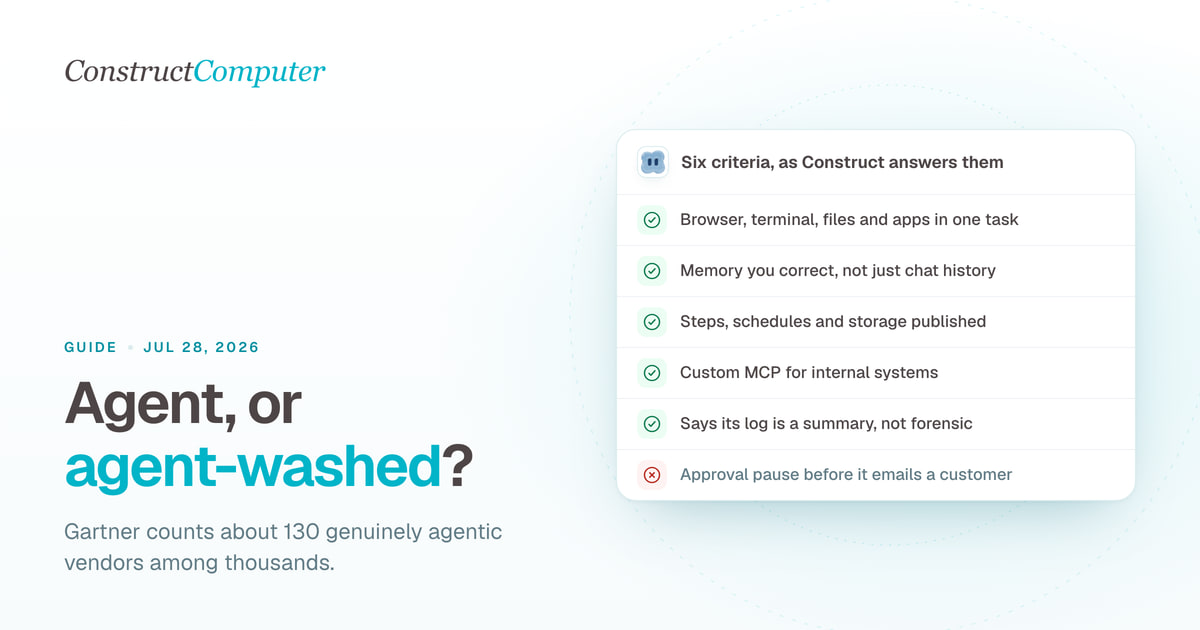
The second pressure is a credibility problem inside the market itself. Gartner estimates that only about 130 of the thousands of vendors marketing “agentic AI” are genuinely agentic; the rest is what Gartner calls agent washing, existing chatbots, RPA, or assistants relabeled for a hotter category (Digital Applied, agent-washing definition and buyer’s scorecard). That is exactly why the checklist above asks what a platform actually does rather than what it calls itself: a chatbot with a new label still cannot orchestrate tools, hold correctable memory, or leave an inspectable trail, no matter what the pitch deck says.
Questions to ask a vendor before you pilot
Bring these questions into a vendor call before you commit engineering time to a pilot. Each maps to one of the six criteria above.
- What can the agent act on beyond chat, and what happens to that work when the session ends?
- What specifically stops the agent from doing something it should not? Look for an explicit allowlist of capabilities, connected apps, and network origins with runtime denial of calls outside that allowlist.
- Is “audit trail” a forensic log or a readable summary? Get an explicit statement rather than implied feature language.
- Can we reach a system you do not already integrate with? Support for custom MCP servers means an internal system can be reached without waiting for first-party support.
- Can the agent be wrong about something and be corrected without losing everything else it knows? Look for versioned memory assertions where a correction supersedes a stale fact while keeping history.
- What is metered, beyond the sticker price? Ask for steps per task, command runtime, concurrent jobs, and storage limits stated plainly.
A 6-point scorecard you can apply to any AI agent platform
Score each criterion against a specific platform before a pilot, not after. A platform that cannot answer a row concretely, only in marketing language, should lose points on that row regardless of how polished the demo looked.
| # | Criterion | Weak signal | Strong signal |
|---|---|---|---|
| 1 | Execution surfaces | Chat plus a fixed plugin list | Browser, terminal, files, and connected-app actions in one task |
| 2 | Human-in-the-loop controls | “Supervised” with no named mechanism | Named interrupt, ask-for-input, and approval behavior, with stated gaps |
| 3 | Audit trail | Vague “full audit trail” claim | Explicit statement of whether it is forensic or a bounded summary |
| 4 | Connector coverage | Fixed integration catalog only | Native catalog plus custom MCP or an equivalent extension path |
| 5 | Memory | Long chat history described as memory | Correctable, provenance-tracked assertions separate from raw history |
| 6 | Pricing and limits | Price with no usage detail | Price plus steps, runtime, concurrency, and storage limits stated plainly |
A team piloting inbound lead qualification, for example, would run this scorecard against each shortlisted platform using the actual job: read a lead email, decide whether it qualifies, update the CRM, and notify the team in Slack. Score row 1 by watching which surface handles the CRM update. Score row 3 by asking, in writing, whether the vendor’s activity record would hold up in a compliance review or only in a weekly stand-up. A platform that scores well on four rows and poorly on two has told you exactly where the pilot needs extra supervision, not whether to abandon it.
Related resources
- The EU AI Act
- Digital Applied: AI agent failure framework
- Digital Applied: Agent-washing definition and buyer’s scorecard
Originally posted on construct.computer.